

 Our Shared Values
 Our Business
 Our Foundations
 Our Achievements
 Our Governance
 Conservation Management & Monitoring
 Climate Change
 Community Engagement
 Partnerships & Memberships
 Human Rights & Labour
 Responsible Sourcing
 Responsible Production
 Certifications
 Sustainability Report
 Palm-based Food Products
 Other Food Products
 Oleochemicals
 Bioenergy
 Food & Nutrition Innovation
 Press Releases
 Stories
 Meet Our Experts
 In the News
 Publication
 Shareholder Information
 Disclosure of Information
 Financial Information
 Prospective Suppliers
 Support for Palm Suppliers
 FAQ
FAQ Existing Non-Palm Suppliers
 Graduates & Professionals
 Scholarships
 Internships

Consumers today are increasingly seeking sustainable and natural ingredients in the products they use every day.
At Sinar Mas Agribusiness and Food, we’re passionate about finding solutions that tick both the boxes – good for people and good for planet. In this interview, Kung Chee Wan, CEO of Oleochemicals, shares how our oleochemicals are leading the charge in sustainable solutions.
Q: What’s the current market climate for oleochemicals?
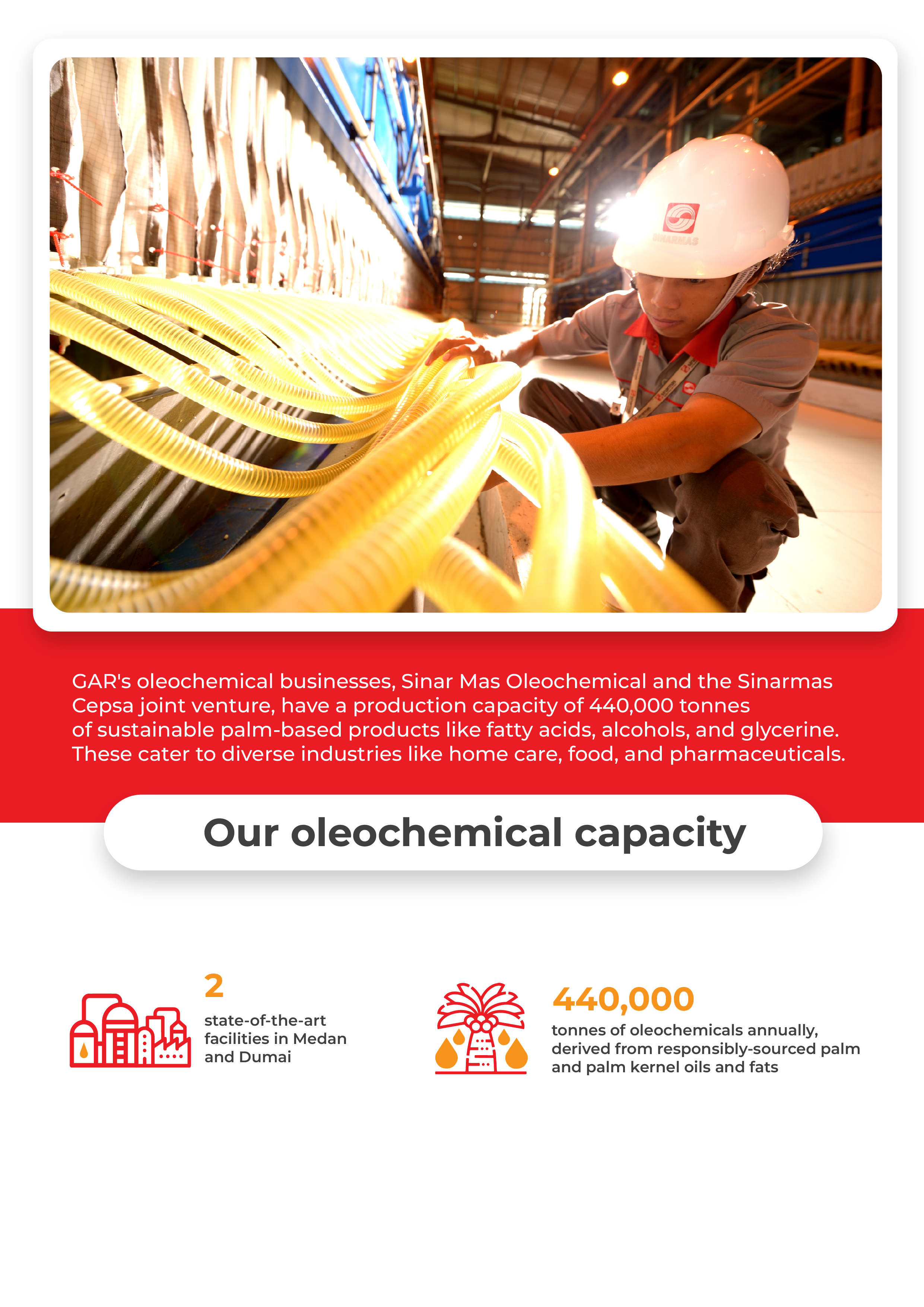
Kung: The oleochemical market saw a bit of price adjustment in 2023, with crude palm oil (CPO) prices coming down after a record year in 2022. While that impacted our revenue, the demand for oleochemicals stayed strong. We saw sales volume climb throughout last year, and that trend continued into the first quarter of 2024. Our downstream business, where crude palm oil gets transformed into oleochemicals, biofuels, and consumer products, accounts for 51 percent of our company’s earnings1 . It indicates that people are increasingly looking for sustainable options, and oleochemicals are hitting the spot.
To meet that demand, we’re constantly looking for ways to grow our business. In our upstream business, we’re using cutting-edge high-yield Dami Mas seeds to boost production in our existing plantations.
For downstream, we’re working to remove bottlenecks, expanding our production capacity, and even venturing into creating new products to make our product portfolio stronger.
We do this while expanding our customer base across the globe – Europe, the USA, Latin America, and the Middle East.
Q: Do you see a greater uptake of palm oil oleochemicals as a result of consumer trends, regulations, and the energy transition (away from fossil fuels)?
Kung: Yes, there’s a noticeable shift, especially with younger generations who are looking for more eco-friendly options in their everyday lives. Think about the soaps, detergents, and beauty products– a lot of them are ditching the chemicals made from fossil fuels and turning to plant-based oleochemicals instead. It’s better for environment and just as effective.
This trend isn’t just present in personal care products. Companies in industries like pharmaceuticals, plastics, and even animal feed are also looking for ways to cut down on their emissions, and plant-based alternatives like oleochemicals are a part of the solution.
Palm oil is a really efficient crop when it comes to producing these oleochemicals. Compared to other options like soybeans or sunflower, it delivers way more oil per hectare of land. Considering that land use for agriculture and forestry contributes to around one-fifth of greenhouse gas emissions, choosing sustainably-produced palm can help to reduce the emissions impact of oleochemical production, without compromising on quality or requiring major reformulation.
“Choosing sustainably-produced palm can help reduce the emissions impact of oleochemical production, without compromising on quality or requiring major reformulation.”

Traceability is another growing requirement in the current global market. New regulations like EU Deforestation Regulation (EUDR) are coming to play, and while some might see these as hurdles, we embrace these as opportunities. We’ve been putting a lot of effort into traceability and sustainable sourcing for years now, and that experience gives us a head start. We’re even going an extra mile by mapping our entire global supply chain, not just for palm but for other products too, such as sugar and soy.
Palm is a versatile plant, and oleochemicals are just one of its many applications. But the possibilities don’t stop there – the food and nutrition space is another exciting area where we’re doing a lot of research and development to bring new palm-based products to market.
Q: What are some examples of your ESG initiatives in Indonesia?
Kung: Climate change is a huge issue for everyone, and it definitely hits close to home for us in this business. That’s why at Sinar Mas Agribusiness and Food, we’re setting ambitious goals to reduce our environmental footprint. We’re aiming to be net zero greenhouse gas emissions by 2050. We’ve signed onto the Agriculture Sector Roadmap to 1.5C, where we are committed to doing our part to keep global warming in check. We’ve also use industry-standard No Deforestation, No Peat, and No Exploitation (NDPE) principles in our operations.
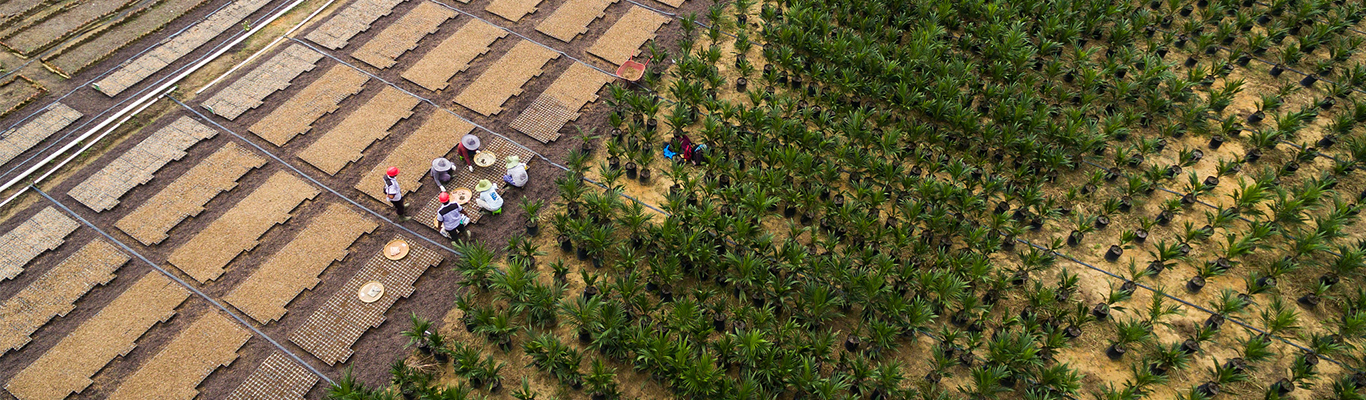
Sustainability and working with communities are part of our DNA. This is the best seen in our upstream businesses where we work with smallholder farmers and local communities in and around our operations in Indonesia. Our Sawit Terampil programme trains these smallholder farmers on sustainable farming practices and helps them get certified. Recently, 270 farmers were certified by the Roundtable on Sustainable Palm Oil (RSPO), the global standard that demonstrates palm oil is produced sustainably and responsibly. Our long-term vision is to train over 100,000 smallholders to farm sustainably by 2035.
Adapted from an interview conducted by Global Business Reports for the Southeast Asia Chemicals 2024 report. Republished with permission.
—–
Discover the ideal palm-derived oleochemicals for your industrial requirements. Click here to explore more and make an informed choice for your needs.
Browse our extensive portfolio of palm-derived oleochemicals designed to meet each customer’s needs here.
—–
1 Specifically Earnings Before Interest, Taxes, Depreciation, and Amortisation (EBITDA)